Showing posts with label Ghana. Show all posts

Wednesday, January 31, 2018

31 January 2010 - Egypt's Multi-Record Setting Goal

On 31 January 2010, Egypt won the Cup of Nations with a record nineteenth consecutive unbeaten match in the tournament, a streak that dates back to 2004.

The run of unbeaten games started in February 2004, when they played to a scoreless draw with Cameroon in the last group stage match (which was also Egypt's last match of that competition, as they failed to advance). And it continued through the 2006 and 2008 tournaments, both of which Egypt won (their fifth and sixth trophies overall).

Then, in 2010, they remained unbeaten to reach the final, where they faced Ghana. Played before a crowd of 50,000 at the Estádio 11 de Novembro in the Angolan capital of Luanda, the match remained scoreless until the 85th minute, when substitute midfielder Mohamed "Gedo" Nagy scored to put Egypt up 0-1. They held on to that margin to claim their record third consecutive Cup of Nations and seventh title overall.

In addition to being their nineteenth unbeaten match, it was also their record ninth consecutive win. The winning streak ended there, as Egypt drew with Mali in the group stage of the 2017 Cup of Nations, but they extended the unbeaten run to 24 before losing to Cameroon in the 2017 Cup of Nations Final. 

Friday, December 29, 2017

29 December 2001 - Alonso's International Debut

On 29 December 2001, Xabi Alonso made his full international debut. And it wasn't for Spain.

The 20-year old midfielder, then in his second season with Real Sociedad, had played for the Spanish U-18s, making a solitary appearance in 2000. Although he had not taken the pitch for them since then, Alonso, who was born in the Basque city of Tolosa, also qualified to play for the Basque Country national team. And in 2001, manager José Ángel Iribar called Alonso up for a friendly against Ghana.

The teams met at the Estadio San Mamés in Bilbao, where the visitors took an early lead with a goal from midfielder Derek Boateng in the 13th minute. Alonso remained on the bench for the first half, then came on at the start of the second with the Basques still down 0-1.

Alonso's entrance, along with several other subs made at the same time, turned the tide for the home side. They equalized in the 46th minute with a strike from Jon Pérez, then got two goals from Óscar de Paula (60', 67') to lead 3-1. Ghana's Alex Takyi-Mensah pulled one back in the 70th minute, but that was the last of the day's goals and the Basques won 3-2.

Although he played primarily for Spain, with 114 appearances between 2003 and 2014, he made four other appearances for the Basque Country, most recently in 2012.

Tuesday, June 6, 2017

6 June 1966 - The Young Yeboah

On 6 June 1966, striker Tony Yeboah was born in Kumasi, Ghana. He went on to become the second black player to appear in the Bundesliga and twice led the league in scoring.

He turned professional in 1981 and spent the first seven years of his career in Ghana. He was the Premier League's top scorer in 1986 and 1987, prompting his move to Germany in 1988 to play for second division Saarbrücken. He was the second black player in the Bundesliga, after his fellow Ghanian international Anthony Baffoe (who was born in Germany). In 1990, he transferred to Eintracht Frankfurt, where his 20 goals in 1992-93 and 18 in 1993-94 tied him for the league's scoring title both seasons.

He joined Leeds in 1994 and became a fan favorite due in part to two memorable goals against Liverpool and Wimbledon, the latter of which was named the Premier League's Goal of the Season for 1995-96.

After three seasons with Leeds, Yeboah returned to the Bundesliga to play for Hamburg from 1997 to 2002, then finished his career with a season at Al-Ittihad Doha in Qatar. Now retired, he is a successful businessman, with his own sports agency and a chain of hotels.

Thursday, January 26, 2017

26 January 1992 - It's Almost Like Nobody Wanted To Win It

On 26 January 1992, every player on the pitch at the end of extra time in the African Cup of Nations Final got to take a penalty kick as Côte d'Ivoire beat Ghana, 0-0 (11-10).

Ghana entered the tournaments as favorites, based on the presence of their star midfielder and captain Abedi Pele, the reigning African Player of the Year. He was the team's high scorer through the earlier rounds and provided the match winner against Zambia in the group stage, but was suspended for the final after picking up a second yellow card against Nigeria in the semifinals.

Meanwhile, Côte d'Ivoire advanced to the final on the back of their outstanding defense, having not conceded a single goal in the tournament. On offense, the team was well-balanced, with each of their goals scored by a different player.

In the final, the day's best chance fell to Ghana, as striker Tony Yeboah chipped the ball over keeper Alain Gouaméné (pictured) and into the path of Ghana midfielder Prince Polley Opoku, but Opoku sent his shot over the bar. The match remained scoreless through extra time, setting up the penalty shootout.

There, the balls flowed into the goal until Ghana's Isaac Asare missed his shot, but Côte d'Ivoire's Joël Tiéhi did the same with the next attempt. The teams went through twelve kickers each, with the last shot taken by Ghana defender Anthony Beffoe. He drove the ball into the waiting hands of Gouaméné to end the match at 0-0 (11-10).

Monday, December 26, 2016

26 December 1903 - Ghana's First Football Club

On 26 December 1903, the 22 members of Ghana's first football club, Excelsior, introduced themselves to the country with an exhibition.

The sport arrived in Ghana--then a British colony known as the Gold Coast--a few years earlier, carried there by European traders. By September 1903, it eventually worked its way to Cape Coast in central Ghana, where it captured the attention of students at the Government Boys School. Their headmaster, the enigmatically-named Mr. Briton, encouraged the boys' interest and, according to one report, 22 of them "embarked upon a secret training course in football."

After three months of night practices held under moonlight, the boys, who named their new club "Excelsior," decided to go public. On 26 December, the 22 split into two teams for an exhibition played on a pitch marked out in Victoria Park, complete with goals. Gold Coast governor Sir Fredric Hodgson attended the match.

The exhibition fomented football's popularity and more clubs followed, including Accra Hearts of Oak, Cape Coast Venomous Vipers, Cape Coast Mysterious Dwarfs, Sekondi Hasaacas and Sekondi Eleven Wise. The national team played their first match in 1950 and the Ghana Amateur Football Association eventually formed in 1957.

Sunday, October 16, 2016

16 October 2009 - Three Is The Lucky Number For Ghana

On 16 October 2009, Ghana won the U-20 World Cup, beating Brazil on penalties, 0-0 (4-3). And they did it despite playing most of the match with only ten men.

It was the third appearance in the U-20 Final for the Black Satellites, who finished as runners-up to Brazil in 1993 and to Argentina in 2001. Brazil, meanwhile, had reached six previous finals and won four of them.

In 2009, Ghana were led by striker Dominic Adiyiah, who had scored a tournament-best eight goals en route to the final, including an extra-time match-winner against South Africa in the Round of 16 and braces against Ghana's 3-2 victories over South Korea and Hungary in the quarterfinals and semifinals, respectively. Brazil had an extra-time victory of their own, needing a pair of late goals from winger Maicon to slip past Germany in the quarterfinals.

In the final, played before a crowd of 67,814 at Cairo International Stadium in Egypt, was an ugly affair for the first half, with two Brazilians seeing cautions and Ghana defender Daniel Addo receiving a 37th-minute red card for a challenge on Brazil's Alex Teixeira. Brazil could not take advantage of the situation, though, and neither team managed to put the ball in the net during the first 120 minutes.

Brazil went first in the penalty shootout and were up 3-2 after four kicks each. But Maicon, who had come on as a 75th-minute substitute, sent his shot high and wide, allowing Adiyiah to pull Ghana level. Ghana keeper Daniel Adjei then guessed correctly on Brazil's next kick to deny Teixiera. The last shot was taken by Ghana midfielder Emmanuel Agyemang-Badu, who coolly slotted the ball into the lower right corner for the win.


Saturday, July 2, 2016

2 July 2010 - God's Other Hand

On 2 July 2010, Uruguay's Luis Suárez saved his team from World Cup elimination with a deliberate handball. Uruguay went on the win the match before getting knocked out in the semi-finals and finishing fourth, their best showing in the tournament since their previous fourth-place finish in 1970.

The handball came in the last minute of extra time in Uruguay's quarterfinal match against Ghana. The teams were level at 1-1, having traded goals from Sulley Muntari (45'+2) and Diego Forlán (55'). Right before time expired, there was scramble in front of Uruguay's goal. The ball fell to Ghana striker Dominic Adiyiah, who headed it toward the net. It would have gone in had Suárez not--very visibly--swatted it away with his hands.

The referee saw the deliberate handball and awarded Ghana a penalty kick while ejecting Suárez from the match. As Suárez marched down the tunnel, Ghana striker Asamoah Gyan fired the ball off the bar and out of bounds. The whistle blew seconds later to send the match into a penalty shootout which Uruguay won, 4-2.

Uruguay advanced to the semifinals, where they lost to the Netherlands, then lost to Germany in the third-place match. Suárez, meanwhile, made a high-profile move that summer from Ajax to Liverpool and established himself as a Premier League stars before moving to Barcelona. Although he drew heavy criticism for his handball, he showed no remorse, saying after the match that "The Hand of God belongs to me now."

Thursday, December 3, 2015

3 December 1982 - Essien Gets Going

On 3 December 1982, former Ligue 1 Player of the Year and BBC African Footballer of the Year Michael Essien was born in Accra, Ghana.

An energetic box-to-box midfielder and tenacious defender, Essien began his professional career in 2000 with French club Bastia. Initially used as a reserve back, he switched to midfield in 2001 and flourished. After only three seasons, he drew attention from bigger clubs and signed with Lyon in 2003.

In two seasons at Lyon, Essien won two Ligue 1 championship medals and, after his second season, was named the 2005 Ligue 1 Player of the Year. That success led to a move to Chelsea in the summer of 2005 after an extended negotiation, with the London club paying what was then a club record transfer fee of £26 million. He made 31 league appearances for Chelsea in his first season as the Blues won the 2006 league title. Essien followed that performance by leading Ghana through the group stage of the 2006 World Cup and claiming the 2006 BBC African Footballer of the Year award.

He later added another league title with Chelsea (2010), as well as four FA Cups (2007, 2009, 2010, 2012), one League Cup (2007), and the Champions League (2012). Essien currently plays for Panathinaikos after joining them in June 2015.

Friday, September 25, 2015

25 September 2001 - This One Didn't Even Get A Name

On 25 September 2001, the Confederation of African Football unveiled the new trophy for the African Cup of Nations. It was the third trophy used since the competition's founding in 1957.

The first African Cup of Nations trophy, which was silver and resembled England's League Cup, was named the Abdelaziz Abdallah Salem trophy, after the first CAF president. When Ghana won the bi-annual tournament for the third time in 1978, the CAF allowed them to keep the trophy and commissioned a new one, named the African Unity Cup. That second trophy, according to the BBC, "was emblazoned with the Olympic rings and with space-age handles and a long stem. "

Cameroon won their third ACN title in 2000 and were allowed to keep the Unity Cup, so the CAF again commissioned the new trophy (pictured). It was first won by Cameroon in 2002, and has since been claimed by Tunisia (2004), and Egypt (2006, 2008, and 2010). Egypt's success meant that they now have permanent possession of the third cup, so the CAF created another new one for the 2012 tournament.

Tuesday, February 3, 2015

3 February 2008 - Going To Agogo

On 3 February 2008, hosts Ghana defeated neighboring rivals Nigeria in the quarterfinals of the 2008 Africa Cup of Nations. The 2-1 win for the Black Stars avenged losses to Nigeria in two of the previous three tournaments.

Playing in Accra's Ohene Djan Stadium before a crowd of 45,000, Nigeria's Super Eagles took a first-half advantage when striker Yakubu Ayegbeni converted a 35th-minute penalty kick. The score momentarily silenced the home crowd, but they soon regained their voice and exploded with joy when Ghana midfielder Michael Essien equalized in the second minute of first-half injury time.

Ghana carried the momentum into the second half and continued to press, despite the sending off of their captain, John Mensah. In the 88th minute, striker Junior Agogo (pictured) netted the match-winner, sending the Black Stars through to the next round.

Perhaps drained from their emotional win over Nigeria, the Black Stars were unable to find the net in their next match, a 1-0 loss to Cameroon, but did not go home empty-handed, beating the Ivory Coast 4-2 in the third-place match.

Tuesday, January 27, 2015

27 January 2001 - Damarcus' Debut

On 27 January 2001, speedy 18-year old midfielder Damarcus Beasley collected his first cap for the United States senior team in a 2-1 friendly win over China played in Oakland, California. Known primarily for his pace on the left wing, Beasley has also shown versatility, playing at forward and left back for the national team.

Beasley had previously been a standout for the U-17s, who reached the semifinals of the 1999 U-17 World Championship, with Beasley earning the Silver Ball award as the tournament's second most valuable player.

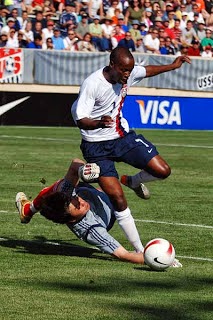
He is the only US international to play in four World Cups--2002, 2006, 2010, and 2014. In 2006, he provided the assist for the only goal scored by the Americans, a 43rd-minute equalizer by Clint Dempsey in the final group stage match against Ghana. Beasley put the ball in the back of the net against Italy, but the goal was disallowed after the referee determined that forward Brian McBride had screened the Italian goalkeeper from an offside position. 

In 2014, he played in all four of the US's World Cup matches, then retired from international football in December of that year with a career total of 121 appearances.  

Wednesday, October 8, 2014

8 October 2005 - Down To The Wire In Africa

On 8 October 2005, African qualification for the 2006 FIFA World Cup came to an exciting conclusion, as four nations secured spots for their first-ever World Cup Finals on the final day.

In Group 1, Togo came from behind twice to defeat Congo 2-3 in Brazzaville. Forward Mohamed Kader (pictured) scored the 70th minute matchwinner after netting an equalizer in the 60th minute. The win put Togo two points clear of Senegal at the top of the table.

Ghana, who needed only a draw to secure their first World Cup berth, topped Group 2 with an 0-4 away drubbing of Cape Verde. The win sent them five points clear of both Congo and South Africa, who played to a 2-2 draw on the final day.

Group 3 was won by Côte d'Ivoire with a 1-3 away win at Sudan. They finished one point ahead of Cameroon, who drew 1-1 at home against Egypt after Cameroonian back Pierre Wome failed to convert a penalty kick in added time, hitting the outside of the post.

Angola guaranteed their trip to Germany with a 0-1 away victory over Group 4 bottom-dwellers Rwanda. The win put Angola level on points with group favorites Nigeria, but Angola advanced on their head-to-head record, having earned a win and a draw against Nigeria earlier in qualification.

The four debutants were joined in the World Cup by Group 5 winners Tunisia, who were making their fourth appearance in the tournament. Of the five African sides, only Ghana advanced out of the group stages with wins over the Czech Republic (2-0) and the United States (2-1), but then fell to Brazil in the first knockout round.

Friday, June 27, 2014

27 June 2006 - This Ronaldo Played For Real Madrid, Too

On 27 June 2006, Brazilian striker Ronaldo Luís Nazário de Lima scored in a World Cup match against Ghana. It was Ronaldo's 15th World Cup goal, breaking the previous record of 14 which had been set in 1974 by West German striker Gerhard "Gerd" Müller.

Ronaldo had already netted twice in the group stages of the tournament and was widely tipped to score the record-breaking goal in the Round of 16 against Ghana. Few predicted the speed with which he would score it, however. In the 5th minute, Brazilian midfielder/forward Ricardo Izecson dos Santos Leite ("Kaká") threaded a pass through to Ronaldo, leaving him one-on-one against the Ghanian keeper. Ronaldo sent the keeper the wrong way, slipped past him and prodded the ball into the empty net.

The goal also set another record - with his third of the tournament, Ronaldo joined German striker Jürgen Klinsmann as the only two people to score at least three goals in three separate World Cups.

Brazil went on to defeat Ghana 3-0, but lost to France 0-1 in the quarterfinals.

Thursday, January 31, 2013

31 January 2010 - A Multi-Record Setting Goal

On 31 January 2010, Egypt won the Africa Cup of Nations with a record nineteenth consecutive unbeaten match in the tournament, a streak that dates back to 2004.

The run of unbeaten games started in February 2004, when they played to a scoreless draw with Cameroon in the last group stage match (which was also Egypt's last match of that competition, as they failed to advance). And it continued through the 2006 and 2008 tournaments, both of which Egypt won (their fifth and sixth trophies overall).

Then, in 2010, they remained unbeaten to reach the final, where they faced Ghana. Played before a crowd of 50,000 at the Estádio 11 de Novembro in the Angolan capital of Luanda, the match remained scoreless until the 85th minute, when substitute midfielder Mohamed "Gedo" Nagy scored to put Egypt up 0-1. They held on to that margin to claim their record third consecutive Cup of Nations and seventh title overall.

In addition to being their nineteenth unbeaten match, it was also their record ninth consecutive win. Both streaks remain active as Egypt failed to qualify for the 2012 and 2013 tournaments.

Saturday, December 29, 2012

29 December 2001 - Alonso's International Debut

On 29 December 2001, Xabi Alonso made his full international debut. And it wasn't for Spain.

The 20-year old midfielder, then in his second season with Real Sociedad, had played for the Spanish U-18s, making a solitary appearance in 2000. Although he had not taken the pitch for them since then, Alonso, who was born in the Basque city of Tolosa, also qualified to play for the Basque Country national team. And in 2001, manager José Ángel Iribar called Alonso up for a friendly against Ghana.

The teams met at the Estadio San Mamés in Bilbao, where the visitors took an early lead with a goal from midfielder Derek Boateng in the 13th minute. Alonso remained on the bench for the first half, then came on at the start of the second with the Basques still down 0-1.

Alonso's entrance, along with several other subs made at the same time, turned the tide for the home side. They equalized in the 46th minute with a strike from Jon Pérez, then got two goals from Óscar de Paula (60', 67') to lead 3-1. Ghana's Alex Takyi-Mensah pulled one back in the 70th minute, but that was the last of the day's goals and the Basques won 3-2.

Although he has since become a regular starter for Spain, with 106 appearances since 2003, he continues to turn out for the Basque Country on occasion, most recently in December 2011.

Wednesday, June 6, 2012

6 June 1966 - The Young Yeboah

On 6 June 1966, striker Tony Yeboah was born in Kumasi, Ghana. He went on to become the second black player to appear in the Bundesliga and twice led the league in scoring.

He turned professional in 1981 and spent the first seven years of his career in Ghana. He was the Premier League's top scorer in 1986 and 1987, prompting his move to Germany in 1988 to play for second division Saarbrücken. He was the second black player in the Bundesliga, after his fellow Ghanian international Anthony Baffoe (who was born in Germany). In 1990, he transferred to Eintracht Frankfurt, where his 20 goals in 1992-93 and 18 in 1993-94 tied him for the league's scoring title both seasons.

He joined Leeds in 1994 and became a fan favorite due in part to two memorable goals against Liverpool and Wimbledon, the latter of which was named the Premier League's Goal of the Season for 1995-96.

After three seasons with Leeds, Yeboah returned to the Bundesliga to play for Hamburg from 1997 to 2002, then finished his career with a season at Al-Ittihad Doha in Qatar. Now retired, he is a successful businessman, with his own sports agency and a chain of hotels.

Thursday, January 26, 2012

26 January 1992 - It's Almost Like Nobody Wanted To Win It

On 26 January 1992, every player on the pitch at the end of extra time in the African Cup of Nations Final got to take a penalty kick as Côte d'Ivoire beat Ghana, 0-0 (11-10).

Ghana entered the tournaments as favorites, based on the presence of their star midfielder and captain Abedi Pele, the reigning African Player of the Year. He was the team's high scorer through the earlier rounds and provided the match winner against Zambia in the group stage, but was suspended for the final after picking up a second yellow card against Nigeria in the semifinals.

Meanwhile, Côte d'Ivoire advanced to the final on the back of their outstanding defense, having not conceded a single goal in the tournament. On offense, the team was well-balanced, with each of their goals scored by a different player.

In the final, the day's best chance fell to Ghana, as striker Tony Yeboah chipped the ball over keeper Alain Gouaméné (pictured) and into the path of Ghana midfielder Prince Polley Opoku, but Opoku sent his shot over the bar. The match remained scoreless through extra time, setting up the penalty shootout.

There, the balls flowed into the goal until Ghana's Isaac Asare missed his shot, but Côte d'Ivoire's Joël Tiéhi did the same with the next attempt. The teams went through twelve kickers each, with the last shot taken by Ghana defender Anthony Beffoe. He drove the ball into the waiting hands of Gouaméné to end the match at 0-0 (11-10).

Monday, December 26, 2011

26 December 1903 - Ghana's First Football Club

On 26 December 1903, the 22 members of Ghana's first football club, Excelsior, introduced themselves to the country with an exhibition.

The sport arrived in Ghana--then a British colony known as the Gold Coast--a few years earlier, carried there by European traders. By September 1903, it eventually worked its way to Cape Coast in central Ghana, where it captured the attention of students at the Government Boys School. Their headmaster, the enigmatically-named Mr. Briton, encouraged the boys' interest and, according to one report, 22 of them "embarked upon a secret training course in football."

After three months of night practices held under moonlight, the boys, who named their new club "Excelsior," decided to go public. On 26 December, the 22 split into two teams for an exhibition played on a pitch marked out in Victoria Park, complete with goals. Gold Coast governor Sir Fredric Hodgson attended the match.

The exhibition fomented football's popularity and more clubs followed, including Accra Hearts of Oak, Cape Coast Venomous Vipers, Cape Coast Mysterious Dwarfs, Sekondi Hasaacas and Sekondi Eleven Wise. The national team played their first match in 1950 and the Ghana Amateur Football Association eventually formed in 1957.

Sunday, October 16, 2011

16 October 2009 - Three Is The Lucky Number For Ghana

On 16 October 2009, Ghana won the U-20 World Cup, beating Brazil on penalties, 0-0 (4-3). And they did it despite playing most of the match with only ten men.

It was the third appearance in the U-20 Final for the Black Satellites, who finished as runners-up to Brazil in 1993 and to Argentina in 2001. Brazil, meanwhile, had reached six previous finals and won four of them.

In 2009, Ghana were led by striker Dominic Adiyiah, who had scored a tournament-best eight goals en route to the final, including an extra-time match-winner against South Africa in the Round of 16 and braces against Ghana's 3-2 victories over South Korea and Hungary in the quarterfinals and semifinals, respectively. Brazil had an extra-time victory of their own, needing a pair of late goals from winger Maicon to slip past Germany in the quarterfinals.

In the final, played before a crowd of 67,814 at Cairo International Stadium in Egypt, was an ugly affair for the first half, with two Brazilians seeing cautions and Ghana defender Daniel Addo receiving a 37th-minute red card for a challenge on Brazil's Alex Teixeira. Brazil could not take advantage of the situation, though, and neither team managed to put the ball in the net during the first 120 minutes.

Brazil went first in the penalty shootout and were up 3-2 after four kicks each. But Maicon, who had come on as a 75th-minute substitute, sent his shot high and wide, allowing Adiyiah to pull Ghana level. Ghana keeper Daniel Adjei then guessed correctly on Brazil's next kick to deny Teixiera. The last shot was taken by Ghana midfielder Emmanuel Agyemang-Badu, who coolly slotted the ball into the lower right corner for the win.

Saturday, July 2, 2011

2 July 2010 - God's Other Hand

On 2 July 2010, Uruguay's Luis Suárez saved his team from World Cup elimination with a deliberate handball. Uruguay went on the win the match before getting knocked out in the semi-finals and finishing fourth, their best showing in the tournament since their previous fourth-place finish in 1970.

The handball came in the last minute of extra time in Uruguay's quarterfinal match against Ghana. The teams were level at 1-1, having traded goals from Sulley Muntari (45'+2) and Diego Forlán (55'). Right before time expired, there was scramble in front of Uruguay's goal. The ball fell to Ghana striker Dominic Adiyiah, who headed it toward the net. It would have gone in had Suárez not--very visibly--swatted it away with his hands.

The referee saw the deliberate handball and awarded Ghana a penalty kick while ejecting Suárez from the match. As Suárez marched down the tunnel, Ghana striker Asamoah Gyan fired the ball off the bar and out of bounds. The whistle blew seconds later to send the match into a penalty shootout which Uruguay won, 4-2.

Uruguay advanced to the semifinals, where they lost to the Netherlands, then lost to Germany in the third-place match. Suárez, meanwhile, made a high-profile move that summer from Ajax to Liverpool and established himself as one of the Premier League's newest stars. Although he drew heavy criticism for his handball, he showed no remorse, saying after the match that "The Hand of God belongs to me now."