Showing posts with label China. Show all posts

Friday, January 26, 2018

26 January 2000 - That Was Probably Some Kind Of Record For Guam, Too

On 26 January 2000, China matched what was, at the time, the world's biggest margin of victory in international football, beating Guam 19-0. That record didn't last long, though.

China had held the record for several years after beating the Maldives 17-0 in 1992, but it finally fell when Tahiti got an 18-0 win over American Samoa in June 2000, then Iran pushed the record to 19-0 with a November 2000 win over Guam in a World Cup qualifier. So the Chinese were motivated to reclaim the title when they began their Asian Cup qualification campaign in January 2000.

On the first day for their qualification group, China beat the Philippines 8-0, while Guam lost to Vietnam 11-0. That set the stage for China to make a run at the top score, and run they did.

Playing at the Thong Nhat Stadium in Vietnam's Ho Chi Minh City, striker Hao Haidong (pictured) got the ball rolling with the opening goal in the second minute, the first of four he scored on the day. He was joined on the scoresheet by Qu Shengqing (5), Su Maozhen (3), Yao Xia (2), Li Weifeng, Shen Si, Qi Hong, and Li Tie before Ma Mingyu scored the final goal with ten minutes remaining.

Unfortunately for the Chinese, however, their reign as joint record holders was short, as about three weeks later, Kuwait beat Bhutan 20-0 in another Asian Cup qualifier. Even that number did not hold up for long; Australia set the current record with a 31-0 win over American Samoa on 11 April 2001.

Friday, August 4, 2017

4 August 1952 - Football For The People

On 4 August 1952, the People's Republic of China played their first football match, losing 4-0 to hosts Finland.

China has had a national team since 1924, when the original Chinese Football Association formed, and they played a handful of matches over the next twenty years, including a couple of Olympic appearances in 1936 and 1948. But following the Chinese revolution, the government of the Republic of China was forced to Taiwan, taking the original association along with them.

Their departure left a gap on the mainland, where the new People's Republic of China created their own Chinese Football Association in 1949. As one of the few countries to recognize the new government, Finland  offered to host the new team and duly beat them 4-0.

Since then, China have slowly improved, qualifying for the 2002 World Cup and twice finishing as runners-up in the Asian Cup (1984, 2004).


Monday, July 10, 2017

10 July 1999 - The US Women Take Two

On 10 July 1999, the United States women won their second World Cup, beating China on penalties and setting an attendance record in the process.

The two teams had grown familiar with one another, meeting three times over the previous five years in the World Cup and the Olympics. The first two of those ended as group-stage draws (3-3 in the 1995 World Cup and 0-0 in the 1996 Summer Olympics). The third was the Olympic Final, which the US won 2-1.

In the 1999 World Cup, they were two of only three teams to emerge from the group stage with wins in all of their matches (Norway was the other). China then beat Norway and Russia to reach the Final, while the US advanced with wins over Germany and Brazil.

They met at the Rose Bowl in Pasadena, California, where a crowd of 90,185 gathered to watch (they were treated to the third-place match as a warm-up, with Brazil beating Norway on penalties). It remains the largest audience ever for a women's-only sporting event.

The teams battled to a scoreless draw through extra-time to send to match to a penalty shootout. There, each team made their first two kicks before US goalkeeper Brianna Scurry stopped China's third shot, taken by Liu Ying, who had come on as a substitute for the shootout.

After two more kicks each, the score was level at 4-4 with the US's fifth shooter, back Brandi Chastain (pictured), still to come. She drove the ball high to the keeper's left and into the net for the victory, then stripped off and her shirt and dropped to her knees in her black sports bra in what became the iconic image of the tournament.

The two teams met again in the 2000 Summer Olympics group stage, playing to another draw (1-1).

Sunday, May 3, 2015

3 May 2003 - FIFA Switches The Pitches

On 3 May 2003, FIFA announced that that year's Women's World Cup, scheduled to start in September, would not be hosted by China as originally awarded.

FIFA had selected China as hosts back in October 2000, choosing them over Australia despite the fact that the Chinese had already staged the 1991 tournament. But in the Spring of 2003, China suffered an outbreak of a virus causing severe acute respiratory syndrome, better known by its acronym SARS. By May, the epidemic had caused over 6,000 illnesses and 400 deaths, most of which occurred in China and Hong Kong.

Amid concerns over the health of their athletes, several governing bodies canceled events that had been scheduled to take place in China that year, including the world track cycling championship, the women's ice hockey world championship, and several WNBA exhibition games, all of which had been moved before FIFA made their decision.

FIFA selected the United States to replace China as hosts. The US had hosted the previous tournament in 1999 and FIFA believed that experience would allow the US to best organize the tournament on such short notice. And, indeed, the tournament went ahead as scheduled, with Germany emerging as the eventual winners.

In order to compensate China for losing the 2003 tournament, FIFA allowed them to keep their automatic qualification status for that year and also named them as hosts for the 2007 tournament, which went off without a hitch (and was also won by Germany).

Tuesday, January 27, 2015

27 January 2001 - Damarcus' Debut

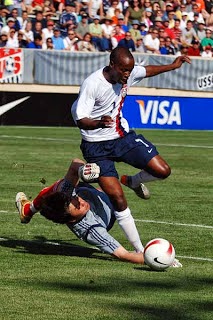
On 27 January 2001, speedy 18-year old midfielder Damarcus Beasley collected his first cap for the United States senior team in a 2-1 friendly win over China played in Oakland, California. Known primarily for his pace on the left wing, Beasley has also shown versatility, playing at forward and left back for the national team.

Beasley had previously been a standout for the U-17s, who reached the semifinals of the 1999 U-17 World Championship, with Beasley earning the Silver Ball award as the tournament's second most valuable player.

He is the only US international to play in four World Cups--2002, 2006, 2010, and 2014. In 2006, he provided the assist for the only goal scored by the Americans, a 43rd-minute equalizer by Clint Dempsey in the final group stage match against Ghana. Beasley put the ball in the back of the net against Italy, but the goal was disallowed after the referee determined that forward Brian McBride had screened the Italian goalkeeper from an offside position. 

In 2014, he played in all four of the US's World Cup matches, then retired from international football in December of that year with a career total of 121 appearances.  

Saturday, January 10, 2015

10 January 1982 - New Zealand's Chinese Take-Out

On 10 January 1982, in what may have been the greatest population disparity in football history, New Zealand (pop. 3 million) beat the People's Republic of China (pop. 1 billion) by the score of 2-1 to qualify for the Kiwis' first-ever World Cup.

New Zealand plays in the Oceania Football Confederation, which, for 1982 World Cup qualification, was competing with the Asian Football Confederation for 2 of the 24 available slots. New Zealand's All Whites--named to contrast with the rugby All Blacks--won their First Round group over rival Australia to advance to the Final Round, along with Kuwait, China, and Saudi Arabia.

New Zealand and China finished tied for second in the Final Round table, even on points and goal difference, and were required to resolve matters through a playoff on neutral territory. They met in Singapore, where the All Whites took a 2-0 lead in the 47th minute. China pushed to break the Kiwis' defense and managed to pull within one after finding the net in the 75th minute, but was stifled after that as New Zealand held on for the win. It was actually New Zealand's second win over China in the group. The first was a 1-0 win in Auckland on 3 October 1981 after drawing 0-0 in Beijing on 24 September 1981.

In Spain for the World Cup, New Zealand was eliminated in the First Round group stage after losses to Scotland, the USSR, and Brazil. But supporters' feelings were represented by New Zealand's then-World Cup Director Charlie Dempsey, who stated "Singapore was our World Cup Final. We have won our World Cup."

Thursday, August 7, 2014

7 August 2004 - Riot In The Streets Of Beijing

On 7 August 2004, Japan defeated China 3-1 in the Asian Cup Final before a crowd of 62,000 at Workers Stadium in Beijing, sparking a riot among Chinese supporters.

The tournament was shrouded in anti-Japanese sentiment, as many Chinese attendees, still angry over Japan's treatment of China during World War II, harrassed the Japanese side, booing anytime they took possession of the ball, displaying political banners denouncing Japan, and drowning out the Japanese national anthem.

Prior to the Final, authorities from both nations expressed concerns about the growing tension. Chinese officials increased the police presence for the match, while the Japanese embassy in Beijing cautioned fans of its national team to avoid drawing attention to themselves. According to the BBC, "tens of thousands" of Chinese supporters were in the stands for the match to watch China's first Asian Cup Final in 20 years.

The match itself was free from violence. The teams were level 1-1 at the half, but Japan went ahead in the 66th minute with a controversial goal from defender Koji Nakata. Replays showed that Nakata's scoring strike went in off of his hand, but the goal was allowed. In any event, Japanese striker Keiji Tamada added an insurance goal in the 91st minute to seal the win.

After the match, the Japanese supporters were driven to safety while Chinese fans started to riot. They burned Japanese flags and sang political songs. Several fights broke out and many bystanders were injured, including a couple of photographers who were beaten by the police.

Friday, August 1, 2014

1 August 1996 - Women's Football Goes Olympic

On 1 August 1996, the United States took the gold medal by defeating China 2-1 in the Womens' Final of the Summer Olympics before a crowd of 76,489 at Sanford Stadium in Athens, Georgia. At the time, it was largest crowd in history to watch a women's sporting event.

It was the first time that women's football had been included in the Olympics. Eight teams qualified and were divided into two groups. The United States and China were in the same group and played each other to a 0-0 draw on 25 July. They both won their matches against group members Sweden and Denmark to finish in the group's top two spots, with China in first place on goal differential.

In the knockout rounds, the United States beat Norway 2-1 (a.e.t.) and China defeated Brazil 3-2 to set up the rematch in the gold medal game.

Midfielder Shannon MacMillan scored first to put the US ahead in the 19th minute, but China equalized in the 32nd minute with a goal from midfielder Sun Wen. In the 68th minute, US forward Tiffeny Milbrett again put the US ahead, then gave way to midfielder Tiffany Roberts three minutes later as the US side protected its lead to the final whistle, claiming the first ever gold medal in Olympic women's football.

Tuesday, July 15, 2014

15 July 2004 - FIFA's Stock In England Hits An All-Time Low

On 15 July 2004, FIFA officially recognized China as the birthplace of football.

FIFA President Sepp Blatter, speaking at the opening ceremony for the Third International Football Expo in Beijing, announced that the organization agreed with the findings of the Chinese Football Association who dated the origins of the game back to approximately 300 B.C. in the city of Linzi in the Shandong Province. At that time, Linzi was the capital of the Qin dynasty.

The ancient Chinese of that period played a sport known as cuju (literally translated as "kick ball"), in which teams from two to 16 people per side competed by kicking a ball stuffed with feathers and hair into small nets placed at the end of bamboo canes. The players could use any part of the body except the hands.

The game grew in popularity through the subsequent Han dynasty (206 B.C.-A.D. 220), which standardized the game and even used it as part of a military training program. In the Tang dynasty (618-907), when the feather-and-hair stuffed ball was replaced with an air-filled one, the sport's popularity continued to increase into all sections of society, including women. It also extended into Korea and Japan. Professional teams developed in the Song dynasty (960-1279) and the sport became strictly regulated.

Cuju began to decline in the Ming dynasty (1368-1644). Around 1900, modern football was introduced, leading to the creation of the CFA in 1924.

Saturday, January 26, 2013

26 January 2000 - That Was Probably Some Kind Of Record For Guam, Too

On 26 January 2000, China matched what was, at the time, the world's biggest margin of victory in international football, beating Guam 19-0. That record didn't last long, though.

China had held the record for several years after beating the Maldives 17-0 in 1992, but it finally fell when Tahiti got an 18-0 win over American Samoa in June 2000, then Iran pushed the record to 19-0 with a November 2000 win over Guam in a World Cup qualifier. So the Chinese were motivated to reclaim the title when they began their Asian Cup qualification campaign in January 2000.

On the first day for their qualification group, China beat the Philippines 8-0, while Guam lost to Vietnam 11-0. That set the stage for China to make a run at the top score, and run they did.

Playing at the Thong Nhat Stadium in Vietnam's Ho Chi Minh City, striker Hao Haidong (pictured) got the ball rolling with the opening goal in the second minute, the first of four he scored on the day. He was joined on the scoresheet by Qu Shengqing (5), Su Maozhen (3), Yao Xia (2), Li Weifeng, Shen Si, Qi Hong, and Li Tie before Ma Mingyu scored the final goal with ten minutes remaining.

Unfortunately for the Chinese, however, their reign as joint record holders was short, as about three weeks later, Kuwait beat Bhutan 20-0 in another Asian Cup qualifier. Even that number did not hold up for long; Australia set the current record with a 31-0 win over American Samoa on 11 April 2001.

Saturday, August 4, 2012

4 August 1952 - Football For The People

On 4 August 1952, the People's Republic of China played their first football match, losing 4-0 to hosts Finland.

China has had a national team since 1924, when the original Chinese Football Association formed, and they played a handful of matches over the next twenty years, including a couple of Olympic appearances in 1936 and 1948. But following the Chinese revolution, the government of the Republic of China was forced to Taiwan, taking the original association along with them.

Their departure left a gap on the mainland, where the new People's Republic of China created their own Chinese Football Association in 1949. As one of the few countries to recognize the new government, Finland  offered to host the new team and duly beat them 4-0.

Since then, China have slowly improved, qualifying for the 2002 World Cup and twice finishing as runners-up in the Asian Cup (1984, 2004).

Tuesday, July 10, 2012

10 July 1999 - The US Women Take Two

On 10 July 1999, the United States women won their second World Cup, beating China on penalties and setting an attendance record in the process.

The two teams had grown familiar with one another, meeting three times over the previous five years in the World Cup and the Olympics. The first two of those ended as group-stage draws (3-3 in the 1995 World Cup and 0-0 in the 1996 Summer Olympics). The third was the Olympic Final, which the US won 2-1.

In the 1999 World Cup, they were two of only three teams to emerge from the group stage with wins in all of their matches (Norway was the other). China then beat Norway and Russia to reach the Final, while the US advanced with wins over Germany and Brazil.

They met at the Rose Bowl in Pasadena, California, where a crowd of 90,185 gathered to watch (they were treated to the third-place match as a warm-up, with Brazil beating Norway on penalties). It remains the largest audience ever for a women's-only sporting event.

The teams battled to a scoreless draw through extra-time to send to match to a penalty shootout. There, each team made their first two kicks before US goalkeeper Brianna Scurry stopped China's third shot, taken by Liu Ying, who had come on as a substitute for the shootout.

After two more kicks each, the score was level at 4-4 with the US's fifth shooter, back Brandi Chastain (pictured), still to come. She drove the ball high to the keeper's left and into the net for the victory, then stripped off and her shirt and dropped to her knees in her black sports bra in what became the iconic image of the tournament.

The two teams met again in the 2000 Summer Olympics group stage, playing to another draw (1-1).

Monday, May 3, 2010

3 May 2003 - FIFA Switches The Pitches

On 3 May 2003, FIFA announced that that year's Women's World Cup, scheduled to start in September, would not be hosted by China as originally awarded.

FIFA had selected China as hosts back in October 2000, choosing them over Australia despite the fact that the Chinese had already staged the 1991 tournament. But in the Spring of 2003, China suffered an outbreak of a virus causing severe acute respiratory syndrome, better known by its acronym SARS. By May, the epidemic had caused over 6,000 illnesses and 400 deaths, most of which occured in China and Hong Kong.

Amid concerns over the health of their athletes, several governing bodies canceled events that had been scheduled to take place in China that year, including the world track cycling championship, the women's ice hockey world championship, and several WNBA exhibition games, all of which had been moved before FIFA made their decision.

FIFA selected the United States to replace China as hosts. The US had hosted the previous tournament in 1999 and FIFA believed that experience would allow the US to best organize the tournament on such short notice. And, indeed, the tournament went ahead as scheduled, with Germany emerging as the eventual winners.

In order to compensate China for losing the 2003 tournament, FIFA alowed them to keep their automatic qualification status for that year and also named them as hosts for the 2007 tournament, which went off without a hitch (and was also won by Germany).

Wednesday, January 27, 2010

27 January 2001 - Damarcus' Debut

On 27 January 2001, speedy 18-year old midfielder Damarcus Beasley collected his first cap for the United States senior team in a 2-1 friendly win over China played in Oakland, California. Known primarily for his pace on the left wing, Beasley has also shown versatility, playing at forward and left back for the national team.

Beasley had previously been a standout for the U-17s, who reached the semifinals of the 1999 U-17 World Championship, with Beasley earning the Silver Ball award as the tournament's second most valuable player.

He was key player for the US in both the 2002 and 2006 World Cups. In the latter, he provided the assist for the only goal scored by the Americans, a 43rd-minute equalizer by Clint Dempsey in the final group stage match against Ghana. Beasley put the ball in the back of the net against Italy, but the goal was disallowed after the referee determined that forward Brian McBride had screened the Italian goalkeeper from an offside position.

To date, Beasley has made 89 appearances for the national team, scoring 17 goals. He currently plays in Scotland for Rangers, after joining the Glasgow side in 2007. He previously played for the Chicago Fire (2000-04), PSV Eindhoven (2004-07), and Manchester City (on loan from PSV, 2006-07).

[2012 Update: Beasley left Rangers for Hannover 96 in 2010, then moved to Mexico to play for Puebla, his current club, one year later.]

Sunday, January 10, 2010

10 January 1982 - New Zealand's Chinese Take-Out

On 10 January 1982, in what may have been the greatest population disparity in football history, New Zealand (pop. 3 million) beat the People's Republic of China (pop. 1 billion) by the score of 2-1 to qualify for the Kiwis' first-ever World Cup.

New Zealand plays in the Oceania Football Confederation, which, for 1982 World Cup qualification, was competing with the Asian Football Confederation for 2 of the 24 available slots. New Zealand's All Whites--named to contrast with the rugby All Blacks--won their First Round group over rival Australia to advance to the Final Round, along with Kuwait, China, and Saudi Arabia.

New Zealand and China finished tied for second in the Final Round table, even on points and goal difference, and were required to resolve matters through a playoff on neutral territory. They met in Singapore, where the All Whites took a 2-0 lead in the 47th minute. China pushed to break the Kiwis' defense and managed to pull within one after finding the net in the 75th minute, but was stifled after that as New Zealand held on for the win. It was actually New Zealand's second win over China in the group. The first was a 1-0 win in Auckland on 3 October 1981 after drawing 0-0 in Beijing on 24 September 1981.

In Spain for the World Cup, New Zealand was eliminated in the First Round group stage after losses to Scotland, the USSR, and Brazil. But supporters' feelings were represented by New Zealand's then-World Cup Director Charlie Dempsey, who stated "Singapore was our World Cup Final. We have won our World Cup."

New Zealand recently qualified for the 2010 World Cup and will make its second ever appearance in the tournament.

Friday, August 7, 2009

7 August 2004 - Riot On The Streets Of Beijing

On 7 August 2004, Japan defeated China 3-1 in the Asian Cup Final before a crowd of 62,000 at Workers Stadium in Beijing, sparking a riot among Chinese supporters.

The tournament was shrouded in anti-Japanese sentiment, as many Chinese attendees, still angry over Japan's treatment of China during World War II, harrassed the Japanese side, booing anytime they took possession of the ball, displaying political banners denouncing Japan, and drowning out the Japanese national anthem.

Prior to the Final, authorities from both nations expressed concerns about the growing tension. Chinese officials increased the police presence for the match, while the Japanese embassy in Beijing cautioned fans of its national team to avoid drawing attention to themselves. According to the BBC, "tens of thousands" of Chinese supporters were in the stands for the match to watch China's first Asian Cup Final in 20 years.

The match itself was free from violence. The teams were level 1-1 at the half, but Japan went ahead in the 66th minute with a controversial goal from defender Koji Nakata. Replays showed that Nakata's scoring strike went in off of his hand, but the goal was allowed. In any event, Japanese striker Keiji Tamada added an insurance goal in the 91st minute to seal the win.

After the match, the Japanese supporters were driven to safety while Chinese fans started to riot. They burned Japanese flags and sang political songs. Several fights broke out and many bystanders were injured, including a couple of photographers who were beaten by the police.

Saturday, August 1, 2009

1 August 1996 - Women's Football Goes Olympic

On 1 August 1996, the United States took the gold medal by defeating China 2-1 in the Womens' Final of the Summer Olympics before a crowd of 76,489 at Sanford Stadium in Athens, Georgia. At the time, it was largest crowd in history to watch a women's sporting event.

It was the first time that women's football had been included in the Olympics. Eight teams qualified and were divided into two groups. The United States and China were in the same group and played each other to a 0-0 draw on 25 July. They both won their matches against group members Sweden and Denmark to finish in the group's top two spots, with China in first place on goal differential.

In the knockout rounds, the United States beat Norway 2-1 (a.e.t.) and China defeated Brazil 3-2 to set up the rematch in the gold medal game.

Midfielder Shannon MacMillan scored first to put the US ahead in the 19th minute, but China equalized in the 32nd minute with a goal from midfielder Sun Wen. In the 68th minute, US forward Tiffeny Milbrett again put the US ahead, then gave way to midfielder Tiffany Roberts three minutes later as the US side protected its lead to the final whistle, claiming the first ever gold medal in Olympic women's football.


Wednesday, July 15, 2009

15 July 2004 - FIFA's Stock In England Hits An All-Time Low

On 15 July 2004, FIFA officially recognized China as the birthplace of football.

FIFA President Sepp Blatter, speaking at the opening ceremony for the Third International Football Expo in Beijing, announced that the organization agreed with the findings of the Chinese Football Association who dated the origins of the game back to approximately 300 B.C. in the city of Linzi in the Shandong Province. At that time, Linzi was the capital of the Qin dynasty.

The ancient Chinese of that period played a sport known as cuju (literally translated as "kick ball"), in which teams from two to 16 people per side competed by kicking a ball stuffed with feathers and hair into small nets placed at the end of bamboo canes. The players could use any part of the body except the hands.

The game grew in popularity through the subsequent Han dynasty (206 B.C.-A.D. 220), which standardized the game and even used it as part of a military training program. In the Tang dynasty (618-907), when the feather-and-hair stuffed ball was replaced with an air-filled one, the sport's popularity continued to increase into all sections of society, including women. It also extended into Korea and Japan. Professional teams developed in the Song dynasty (960-1279) and the sport became strictly regulated.

Cuju began to decline in the Ming dynasty (1368-1644). Around 1900, modern football was introduced, leading to the creation of the CFA in 1924.