Saturday, March 31, 2012

31 March 2010 - He May Have Barcelona DNA, But His Heart Was All Arsenal

On 31 March 2010, Arsenal captain Cesc Fàbregas scored the equalizing goal against Barcelona in the Champions League quarterfinal. And he did it with a broken leg.

Fàbregas, who joined Arsenal in 2003 after five years at Barcelona's youth academy, had been the subject of longstanding transfer rumors linking him with a return to his former club, adding a lot of spice to the match-up.

Barcelona, as the reigning champions, were heavy favorites, but the Gunners managed to hold them to a scoreless draw until the break. Less than one minute after the restart, however, a long pass went over the Arsenal backline to a racing Zlatan Ibrahimović, who beat keeper Manuel Almunia with a lobbed ball to the far post. He then doubled the lead in the 59th minute, after another overhead ball left him one-on-one with Almunia. But Arsenal midfielder Theo Walcott narrowed the gap ten minutes later with a precise finish.

As Arsenal pushed forward for an equalizer, Barça's Carles Puyol fouled Fàbregas in the box in the 85th minute. Fàbregas stepped up to the spot and converted the ensuing penalty, then immediately afterward started limping. It appeared that he pulled a muscle, but scans later revealed that Puyol's foul had resulted in a small fracture in his right fibula.

The injury forced Fàbregas to miss the return leg, which Barcelona won 4-1. He remained with Arsenal for one more season, then transferred to Barça in August 2011 for £29 million.


Arsenal vs Barcelona 2-2 31/03/2010 Highlights by

Friday, March 30, 2012

30 March 2010 - C'était Une Affaire Française

On 30 March 2010, Lyon and Bordeaux met for the first all-French contest in the Champions League, with Lyon emerging as 3-1 winners.

Bordeaux, the reigning Ligue 1 champions, were again at the top of the table, four spots above Lyon, and had beaten them in the league back in December. The Girondins had also gotten off to a flying start in the Champions League, winning six of their first seven matches to reach the quarterfinals (the other was a 1-1 draw with Juventus in the group stage). There, they met Lyon, who had just eliminated Real Madrid in the Round of 16.

The teams' meeting at Lyon's Stade Gerland was a first, as French teams had met five times previously in UEFA competitions, but never before in the Champions League. Lyon marked the occasion by taking a 10th-minute lead with a goal from striker Lisandro López (pictured). Not to be outdone, Bordeaux forward Marouane Chamakh drew the visitors level four minutes later.

Lyon regained the lead in the 32nd minute with a goal from Michel Bastos, then sealed the win with a 77th-minute penalty kick from López. That final goal proved to be crucial, as Bordeaux won the second leg 1-0, but lost 3-2 on aggregate.


Lyon vs Bordeaux 3-1 30 03 2010 Highlights by hhhlllify

Thursday, March 29, 2012

29 March 2000 - (Un)Welcome Home, Wales

On 29 March 2000, Wales played their first match at the new Millenium Stadium in Cardiff. And lost 1-2.

Built on the site of the old national ground, Cardiff Arms Park, construction on the stadium finished in the summer of 1999 at a total cost of £121 million. The Welsh rugby team hosted the first major event there, beating South Africa in a friendly.

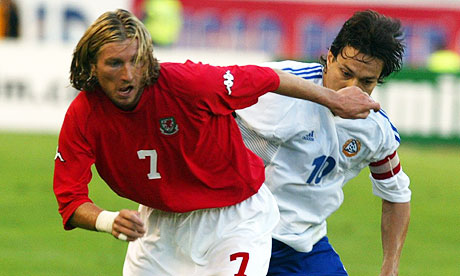
The football team's turn came the following spring, as they hosted Finland in a friendly of their own. A crowd of 65,000 showed up for the event, setting a new national team record (though it has since been broken). Unfortunately for the home fans, however, Finnish midfielder Jari Litmanen (pictured, battling Wales' Robbie Savage) scored the opening goal in the 21st minute. Welsh striker Nathan Blake found the back of the net in the 42nd minute, but it was the wrong net, putting the Finns up 0-2.

Ryan Giggs pulled one back in the 60th minute, but that was the last goal of the day and Finland left as 1-2 winners.

Wednesday, March 28, 2012

28 March 1897 - Born To Run (The German National Team)

On 28 March 1897, Josef "Sepp" Herberger was born in Mannheim, Germany. He went on to manage the German national team for almost thirty years, winning a World Cup in the process.

A striker, Herberger's playing career lasted from 1914 to 1930 and included spells with Waldhof Mannheim (1914-21), VfR Mannheim (1921-26), and Tennis Borussia Berlin (1926-30). During that time, he also made three appearances for the German national team.

But he made his greatest mark as a manager, starting with Tennis Borussia in 1930. Two years later, he joined the German national team as an assistant coach, then took the top job in 1936. Renowned as a tactical genius, his first crack at a World Cup ended poorly, as Germany were eliminated in the first round that year by Switzerland. And they were banned from the next tournament, in 1950, due to Germany's role in World War II.

But in 1954, as the manager of the West German team, he finally claimed football's ultimate prize, upsetting tournament favorites Hungary in the final. Hungary, who had beaten the Germans 8-3 in the group stage, took a 2-0 lead after only eight minutes, but Herberger's team rallied to claim a 3-2 victory that has since been dubbed "the Miracle of Bern."

He returned to the tournament as West Germany's manager in 1958, finishing fourth, and again in 1962, when they were eliminated by Yugoslavia in the quarterfinals. He retired in 1964 having won just over 64 percent of his games. He later died in 1977 at the age of 80.

Tuesday, March 27, 2012

27 March 1988 - Kundé Claims The Cup For Cameroon

On 27 March 1988, Cameroon won their second African Cup of Nations, beating Nigeria with a second-half penalty from defender Emmanuel Kundé. It was Cameroon's third trip to the final and the second one in which they faced Nigeria (they beat the Super Eagles 3-1 in 1984 to claim their first title).

The two teams were paired in the same group for the 1988 tournament and had played to a 1-1 draw. Nigeria went on to top the group, with Cameroon in second. Cameroon advanced to the final with a 1-0 win over Morocco, while Nigeria claimed their spot by beating Algeria on penalties, 1-1 (9-8).

Throughout the tournament, goals were scarce. With a total of sixteen matches, teams scored more than one goal only twice. The final, played before a crowd of 60,000 at the Stade Mohamed V in Casablanca, continued that trend, as the teams played to a hard-fought scoreless draw at the break. Ultimately, they were separated only by a 55th-minute penalty kick, duly converted by Kundé to seal the win for Cameroon.

Since then, the Indomitable Lions have won the cup twice more (2000, 2002) to take their overall total to four. Nigeria, meanwhile, has two cups of their own, won in 1980 and 1994.

Monday, March 26, 2012

26 March 1983 - A Final Cup For Paisley's Cupboard

On 26 March 1983, Bob Paisley, Liverpool's most decorated manager, won his last major cup, beating Manchester United in the League Cup Final, 2-1.

Paisley spent his entire professional career at Liverpool, playing there from 1939 to 1954, then joining the coaching staff. When manager Bill Shankly retired in 1974, Paisley took charge and proceeded to win an astounding club-record 20 major trophies, including six league titles and three European Cups. The 1982-83 season was his last at Anfield and he went out in style, winning his last two pieces of silverware.

The first of the two was the League Cup, his final tournament trophy. Playing before a crowd of 99,304, Liverpool faced Manchester United and quickly fell behind after United forward and captain Norman Whiteside scored in the 12th minute. They were still trailing deep into the second half until left back Alan Kennedy equalized in the 75th minute.

Still level at 1-1 after 90 minutes, the match went into extra time, where Liverpool midfielder Ronnie Whelan scored in the 98th minute. It proved to be the match-winner, giving the Reds a 2-1 victory.

Liverpool went on to give Paisley his final trophy by winning the league that season, finishing eleven points clear of runners-up Watford.

Sunday, March 25, 2012

25 March 2006 - Reading Rockets To The Top

On 25 March 2006, Reading FC secured promotion to the Premier League with a 1-1 draw at Leicester City. And they did it in record time.

As recently as 2002, they were in Division Two, but they won promotion to Division One that year, then reached the Championship in 2004. In their second season there, they got off to a poor start, losing to Plymouth 1-2 on opening day. But they followed that loss by going unbeaten for their next 33 league matches--they lost only twice all season. Along the way, they took the table's top spot in November and held on to it for the duration.

Going into their match against Leicester City, Reading were 16 points clear of second-place Sheffield United, with seven matches left to play for both teams. Critically, they were also nineteen and twenty points clear, respectively, of Walsall and Leeds United, who were the other teams in contention for the top two automatic promotion spots.

Approximately 3,000 Reading supporters made the trip to Walkers Stadium--part of an overall crowd of 25,578--only to see the visitors go down 1-0 in the 38th minute due to a goal from Leicester's Iain Hume. But they equalized with a header from Kevin Doyle in the 85th minute and escaped with a draw. As it turned out, the results from the day's other matches meant they would have secured a top-two finish even with a loss.

It was their first promotion to the top flight and it was the earliest any team had guaranteed promotion since the league went to a 46-game season. Unfortunately for Reading, they stayed in the Premier League for only two seasons before dropping back down to the Championship in 2008.